
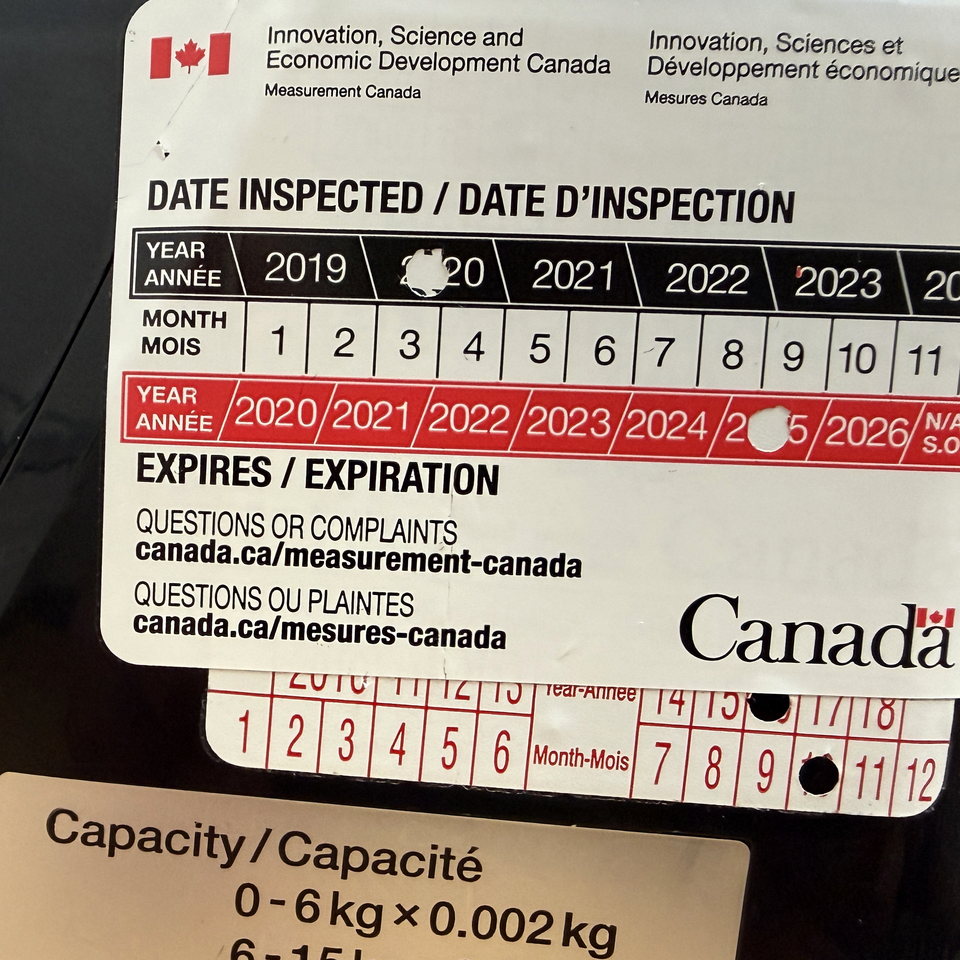
If you sell ham, produce, or bulk by weight, there are two numbers on the scale, the price and the weight in whatever unit of measurement (kilograms or pounds) is relevant to the commodity being sold. When purchasing weighed product, your customer is not thinking about the scale or the POS setup at all. They are looking at the platter, then the product, then the amounts on the display, and eventually then at the label slapped on the package and then the receipt at the end of the checkout (and probably hold up the line for a few seconds making sure it’s all rung up correctly!). Ultimately the customer expects all the numbers to agree, and they can, because Measurement Canada regulates weighed commerce in Canada, and those regulations provide Canadians a level of trust that makes weighed commerce viable.
For a scale to be “legal for trade”, the device has to be approved for use, which means it has been examined by a Measurement Canada accredited representative, tested, sealed, approved, and the approval label affixed to the scale is still valid. If any of that is missing, the independent Ontario grocer, butcher, bakery, deli, or produce market has a “trade” problem. Oh and by the way, just because it’s legal for trade in the United States, doesn’t mean it’s legal for trade here in Canada, and certainly not without an examination. Your POS of course still matters, but it cannot paper over a scale that is not legal for the sale.
Understanding Legal For Trade
Under the Weights and Measures Act, trade is selling or buying on the basis of measure. A weighing machine used for that is a device. Anything attached to it that can affect accuracy is part of the device too, which is why a scale wired to a cash register or a computer is not just a platter sitting on the counter.
To understand when a legal for trade scale comes into play simply ask yourself the following question: “Is the price to the customer determined by a direct calculation as a result of the weight?” If yes, you need the scale to be legal for trade.
What about a back-room portion or receiving scale when measuring recipes, ingredients, counting inventory, or doing production? Ask yourself this question: “Are you setting a price on the scale when you weigh the product, and as a result of that weight are you labeling and selling the product at a price directly related to the calculation of that price by weight?” If the answer is no, then you likely do not need the scale to be approved for trade. Therefore, you cant assume every restaurant or kitchen scale is legal-for-trade, or needs to be legal for trade, and do not assume it is exempt either. If you are not sure, ask Measurement Canada or an authorized service provider (ASP).
Three Factors
For Canadian merchants, it’s important to understand that the manufacturer’s badge on the side of the scale is not the whole story. In Canada, legal for trade encompasses three main things and all of them are required:
1. Type approval. The make and model must have a Measurement Canada notice of approval. This indicates that the scale is known to Measurement Canada and has been determined to be capable and therefore possible for use for trade in Canada. However, it isn’t sufficient alone to make it legal. To find out if your scale can even be certified in Canada for use, you can visit Measurement Canada’s website for Approval Notices (https://www.ised-isde.canada.ca/site/measurement-canada/en/type-approval/find-notice-approval) by manufacturer and model.
2. Examination before first use in trade. An Measurement Canada inspector, examines the device, issues a certificate, marks it, and puts seals on so later adjustments are evident.
3. Subsequent examination on a schedule. Lastly, the certification status of the scale must be kept up to date. The next due date is on the certificate and on the sticker. In Measurement Canada’s merchant documentation, that later visit is called recertification.
As mentioned above, an American/US NTEP certificate, or a NIST Handbook 44 sticker, is not an acceptable substitute for a Measurement Canada approval and certification. For that reason, a scale that is legal for trade in a US state is not automatically approved for use in trade in Canada, so merchants beware.
How Often Must I Recertify?
If you sell food at retail by weight, you are probably on a five-year cycle. That covers grocery and supermarket, deli, butcher, produce, bulk, farmers’ market, fish, candy and nut, and similar shops like them. The device types Measurement Canada names in that sector include point-of-sale, computing, platform, and overhead rail scales. See mandatory examination frequencies and the retail food sector table.
Five years is the recertification requirement for the retail-food sector. It is not the same for other industries that often have completely different scale requirements, for example, grain elevators, dairy wholesale, or forestry merchants. If the same scale is used in more than one sector, the closest next due date is the one that counts.
If the sticker is overdue, Measurement Canada treats a missed mandatory examination as an offence, and a warning can require examination within 14 days. Their compliance and enforcement fact sheet publishes administrative penalties and court-imposed fines. It’s not worth taking chances on scale recertifications. Check the last certificate or the inspection sticker, and see whether recertification is due.
Integrated Scales
Ask a scale technician what matters and they may talk about the scale features. Ask a POS sales rep and they may talk about the software. The part that usually gets skipped is the cable between them requiring a legal for trade certification that must be obtained for the scale after it is connected to the system and installed onsite.
Measurement Canada’s “field-inspection” requirement considers the scope of a scale-integrated POS system to be a weighing element or non-computing scale interfaced with an electronic cash register or computer for direct sales to a consumer, and in its environment. A stand-alone price-computing scale is a different animal, even though both can be used in trade.
The receipt has to show net weight, price per unit, computed price, and the product name or code, in a format an inspector can read. Units print as kg or lb. Not lbs. Not #. That is a small thing on the tape and a real thing at examination. If it’s unacceptable to the inspector, the scale fails and the scale must be labelled, “Not Legal For Trade” until it is fixed and re-inspected.
Both the operator and the customer must be able to see both the price and the weight of the commodities being weighed during the transaction at all times during the transaction. This often means that the checkout design and the position of both the scale’s operator and customer displays need to be considered when installing the point of sale system.
If someone breaks a seal to “just fix” the scale, that is an offence unless it is done to alter, adjust, or repair the device and then reported as prescribed. A store manager with a screwdriver is not recertification. If a seal is broken by a merchant or is found broken on a scale, a broken-seal report must go in writing to the nearest Measurement Canada office within five days, likely to require an examination and recertification by an authorized service provider (ASP).
Check Your Scales Now
Any merchant can go out to the retail floor and check the following things to make sure they are in compliance:
- Find the examination sticker and the certificate, and write down the next due date. Stick it in your calendar or better yet, delegate the calendar task to one of your staff.
- If you cant find a sticker, confirm the make and model against Measurement Canadas notice-of-approval search.
- Look at the seals. If a seal is broken, stop using that scale in trade and call an ASP who can recertify. Do not “fix” it and put tape over the hole.
- If the scale is wired or wirelessly connected to the POS, treat the receipt layout and the interface as part of the whole measuring system.
- Kitchen prep or production, receiving and bar inventory scales that never determine the customer’s price may not be the same obligation. Double check the regulations with Measurement Canada and or ask your ASP.
Regardless of who you bought your scales from, how old they are, or how technically saavy you and your staff is, the merchant is ultimately responsible for accuracy even after an examination. For more information, Measurement Canada’s own merchant explainer is a good resource Accuracy: It’s Your Responsibility. It’s easy to keep them up to date, and now that you understand how and why, now is a good time to go check your scales for Measurement Canada compliance!
Remember, at all times you can always call us here at Armagh for assistance or recertifications. We’re happy to assist any merchant looking to stay in compliance.
Note: Not legal advice. Always check your specific circumstances with your ASP or Measurement Canada.
About Armagh POS Solutions
Armagh POS Solutions is a Hamilton-based POS specialist serving Canada’s retail, restaurant, and grocery industries since 1979. We deliver complete point-of-sale systems for single-location independents and multi-unit chains: Catapult Retail POS, Genius Restaurant POS, cash registers, Ishida and other commercial scales, Toshiba terminals, self-checkout, mobile POS, self-service kiosks, online ordering, loyalty, liquor inventory, grocery labelling, and integrated credit and debit. Our team consults on process automation, inventory accuracy, customer-service speed, and restaurant order management, then installs, trains, and supports the system 24/7. Armagh has been a big name in small business for 45+ years.